Showing posts with label fat burning. Show all posts

5.30.2012

HIIT: How To Become a Fitness Machine

Pin It Print Friendly and PDF
Studies show that 27 minutes of HIIT 3x per week burns MORE CALORIES than 60 minutes of steady 5x per week. That means 81 minutes (1 hour, 21 minutes) of exercise can burn more calories than 300 (5 HOURS!). Whoa. Let's investigate that amazingness, am.i.right?

Interval Training, in general, consists of alternating high and low intensity exercises. This burns more calories than steady state cardio, builds lean muscle faster, and boosts your metabolism for longer. HIIT: High Intensity Interval Training, more specifically, has two parts:
  1. Maximum Oxygen Use (VO2 Max) in a quick burst of exercise: VO2Max is the maximum amount of oxygen your body can consume during a given exercise. Reaching (or getting close to) your body's VO2 Max will cause your body continue to consume O2 for 48 hours after you've finished working out. That means your body must burn more calories at a faster rate in order to fill the oxygen void. This speeds up your metabolism for the entire day.

  2. Maximum Effort to fatigue your muscles: HIIT is aerobic and anaerobic exercise (while steady state running, for example, is just aerobic). First, you are getting an aerobic exercise as your body uses up oxygen-generated energy. Then, once you have reached your VO2 Max, your body shifts into anaerobic exercise, which does not use oxygen (because there is none to be used!).
There are a few different types of HIIT workouts, but here are some tried and true favorites:

Tabata                                    

Basics:
  • 20 seconds HIGH intensity followed by 10 seconds REST.
  • Total of 4 minutes.
  • Perform 2-4 times a week.
  • Best for people who are already fit and want an efficient workout.
Method:
  • 3-5 minute warm up
  • 20 seconds sprint
  • 10 seconds rest or walk
  • Repeat sprint/walk 7 more times for a total of 8

Little                                     

Basics:
  • 60 seconds high intensity followed by 75 seconds low intensity.
  • Total of 27 minutes.
  • Perform 3 times a week.
  • Best for intermediate exercisers who have 30 minutes to spare.
Method:
  • 3-5 minute warm up
  • 60 second sprint (or cycling at maximum ability)
  • 75 seconds jog (or cycling with low resistance)
  • Repeat 11 more times for a total of 12

Turbulence                          

Basics:
  • 8 rep sets alternated with 1-2 minute cardio sets.
  • Maximum 45 minute length.
  • Perform 3 times a week. 
  • Best for intermediate exercisers who have 45 minutes and want to incorporate weights into HIIT
Method:
  • 5 minute warm up
  • 8 rep set of weight lifting
  • 1 minute of mountain climbers or burpees

So, ready to jump on the HIIT train? Perhaps you'll just take a trial run. Here are a few workouts build on HIIT methodology:

  • Stairmaster Sprint Fat Burning Workout: Utilizes multiple Tabata sprints within a fat burning workout in a way that maximizes metabolism but keeps it low impact.
  • Summer Shape Up Whole Body Tabata Workout: Built on 6 Tabata sequences with short breaks in between, this workout uses low weights to get your heart rate up, then sculpt and tone your whole body.
  • Full Body Cardio in 10 Min: Actually, the true HIIT workout only takes 4 minutes in this workout, but it includes a brief warm up and cool down in the 10 minutes. You'll be out of breath but feeling fabulous.


Additional Resources and Credits:
http://www.greatist.com/fitness/interval-training-complete-guide/

5.24.2012

Stairmaster Sprint Workout (Low Impact, High Intensity Fat Burning)

Pin It Print Friendly and PDF
Sprinting does wonders for your body. It pushes your muscles and cardiovascular system to their maximum fat burning potential. Unfortunately, most workouts that allow for sprint-like exercise also involve a lot of impact. That means that, while you're undoubtedly doing some major fat burning, you may also be doing damage to your joints and bones.

This workout takes the cake (how cruel of me to mention cake in a workout routine post). It can be done on any stair master that will monitor your heart rate (or you can use a heart rate monitor). The great thing about this workout is that you can get all of the benefits of sprinting for over ten minutes... without the impact.

In addition to an amazing sprint period, this workout maximizes your fat burning potential. Most of us skip over our body's fat burning phase and settle into aerobic or steady state workouts... yet, the most crucial parts of burning fat are hitting your fat burning phase and your anaerobic phase. This workout ensures that you burn fat the entire time, both before and after your sprint.

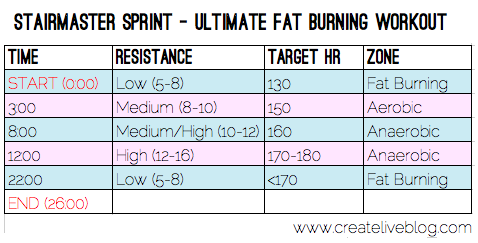
Here's the workout!


0-3 Minutes: Warm Up in Fat Burning Zone
  • Begin at level 5. Watch your heart rate slowly climb as you increase the speed (but try to stay between 5 and 8). Your goal should be to meet your 50-60% mark, then keep it there.
3-8 Minutes: Heart Rate Climb in Aerobic Zone
  • Begin at level 8. Watch your heart rate slowly climb as you increase the speed (but try to stay between 8 and 10). Your goal should be to meet your 60-70% mark, then keep it there.
8-12 Minutes: Stairmaster Sprint in Anaerobic Zone
  • Begin at level 10. Each time you increase the speed, your heart rate will slowly rise for a bit, then it may plateau and begin to fall again. This is normal. Watch for your heart rate to start slowing down, then speed the machine up by 1 level. Try to stay between 10 and 12, aiming for the lower part of your Anaerobic zone (but if you're climbing higher and have the energy, feel free to let this blend into the next segment).
12-22 Minutes: Stairmaster Sprint in Anaerobic Zone
  • Begin at level 12. Each time you increase the speed, your heart rate will slowly rise for a bit, then it may plateau and begin to fall again. This is normal. Watch for your heart rate to start slowing down, then speed the machine up by 1 level. Try to stay between 12 and 16, aiming for the higher part of your Anaerobic zone.
22-26 Minutes: Cool Down in Fat Burning Zone
  • Keep the level somewhere between 5 and 8. This will allow your body to cool down while keeping it in fat burning mode to burn the fat cells just released by the intense segments of the workout. Your heart rate may initially speed up, as your body realizes it no longer needs to conserve energy for the rest of the workout. By the end of the 4 minute cool down, however, your heart rate should be slowly but steadily dropping.


Some Notes:
This workout is based on spending time in your fat burning zone (50-60% of your Max Heart Rate), then swiftly moving up into your aerobic zone (60-70% of your Max Heart Rate) and anaerobic zone (70-80% of your Max Heart Rate), then coming back down into your fat burning zone. 


Before starting this workout, you might want to calculate your heart rate zones.
I have included some basic numbers that predict your zones based on age, but keep in mind that an extremely fit 30 year old's heart rate zones will be higher than an unfit 30 year old. This is because heart rate zones are based on what you are capable of doing with your body and heart... and the more truly fit you are, the more you will be capable of doing with your body and heart.Your Maximum Heart Rate (MHR) starts at 220 beats per minute and falls by one beat per minute every year after birth. Once you reach age 30, the rate of decrease is .5 instead of 1. To calculate your maximum heart rate...
  • If you are <30 Years Old: 220 - Age
  • If you are >30 Years Old: 190 - .5(Years Over 30)
To make it simpler, here are some brackets (these are only estimates):
  • If you are 20-25: 195-200bpm
  • If you are 25-30: 190-195bpm
  • If you are 30-40: 185-190bpm
  • If you are 40-50: 180-185bpm
  • If you are 50-60: 175-180bpm
  • If you are >60: 160-175bpm
Why do those numbers matter? Because, while the workout below is a general suggestion (based on a MHR of someone in their 20s) and will be safe as long as you push yourself, you may want to adjust the numbers if you are just beginning working out or in an older age bracket (or if you're just an extremely detailed person!). So, if your maximum heart rate is lower due to age or inactivity, you can get the best workout for your body by lowering each target heart rate by 5-20 points, depending on the calculations above.


*Many thanks to CalculateNow for the heart rate zone image.
**As usual, you should consult a physician before starting any exercise regimen. I am not a doctor nor a certified trainer, so please don't sue me**
Related Posts Plugin for WordPress, Blogger...
Blogging tips